Build, Buy, or Outsource? A Domain-Driven Design (DDD) Approach to Strategic Technology Decisions

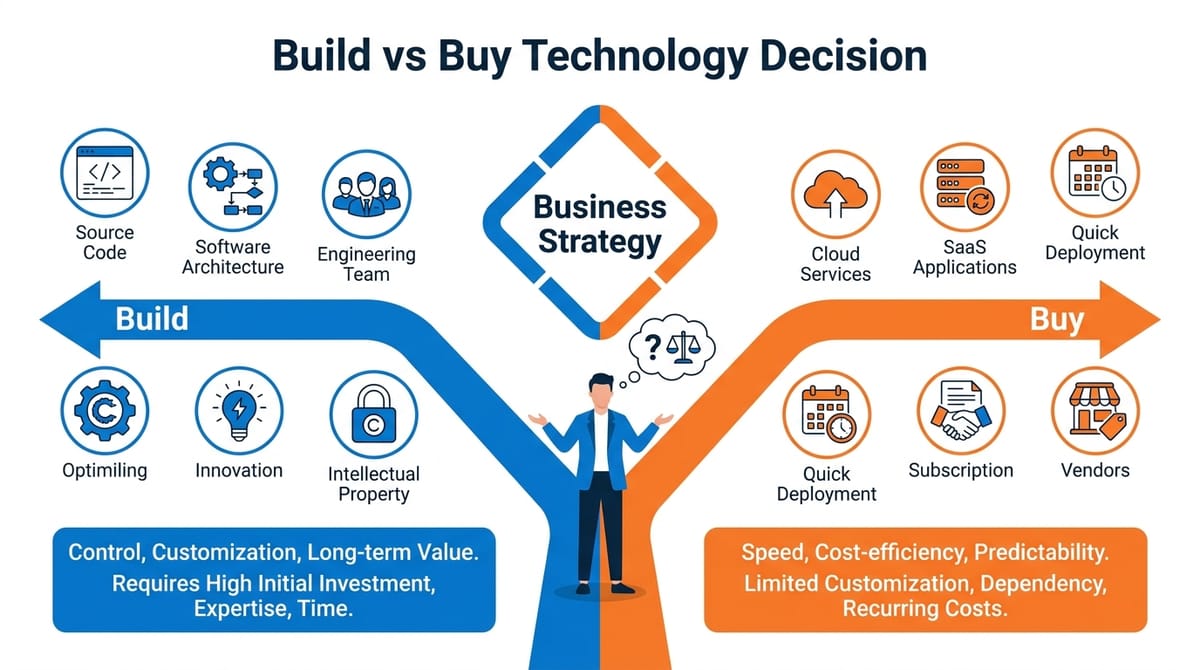
Before deciding whether to build software internally or purchase an existing solution, organizations should first understand which part of the business the software supports. The answer is not purely technical—it is a strategic business decision.
Introduction: Why Build vs Buy Matters
Every organization eventually faces the question:
Should we build this solution ourselves or buy an existing product?
Building software requires significant investment in engineering talent, maintenance, and long-term ownership. Buying software accelerates implementation but may limit flexibility and differentiation.
The right decision depends on how strategically important the capability is to the business.
Understanding Technology Solutions
Not every software system contributes equally to business success.
Some systems create competitive advantage.
Others simply help run the business efficiently.
Understanding this difference is the foundation of Build vs Buy decisions.
Business Domains and Subdomains
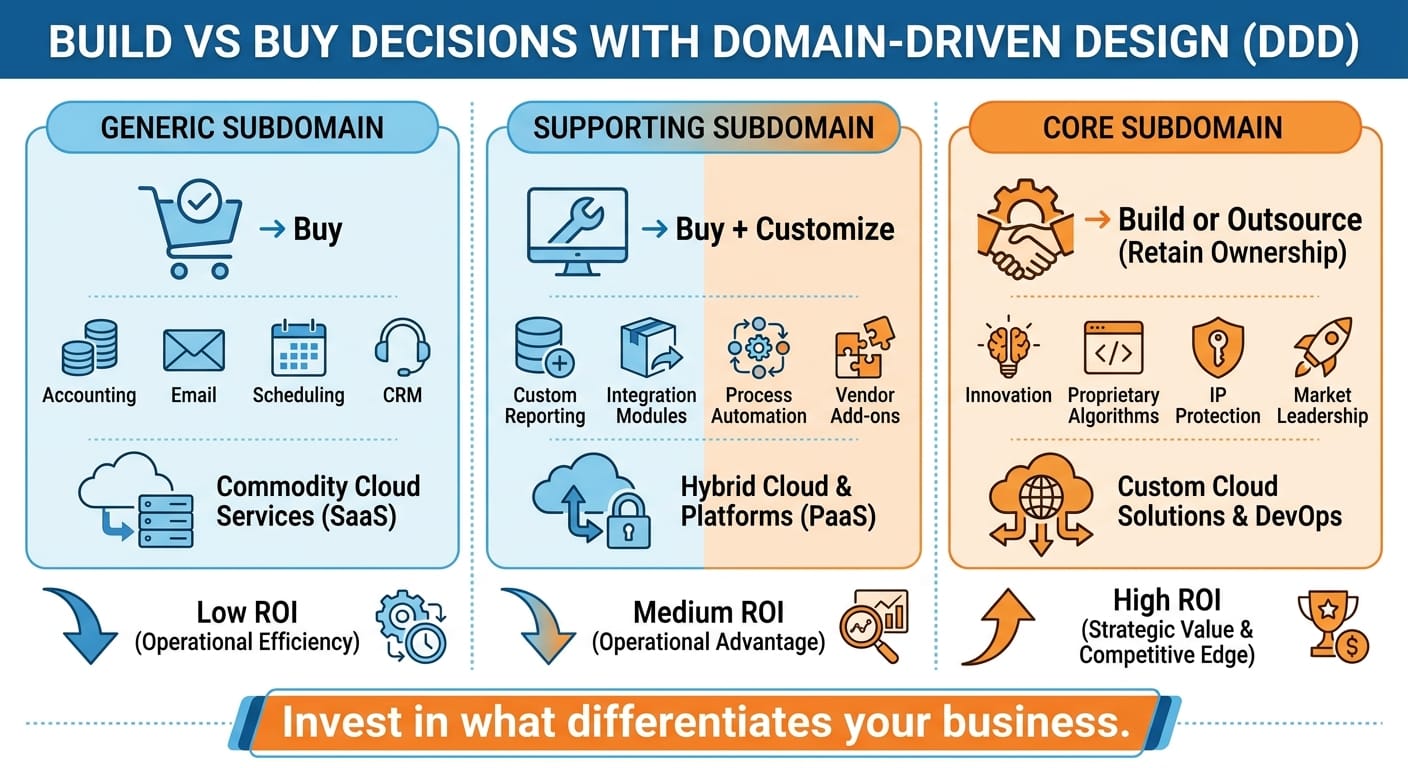
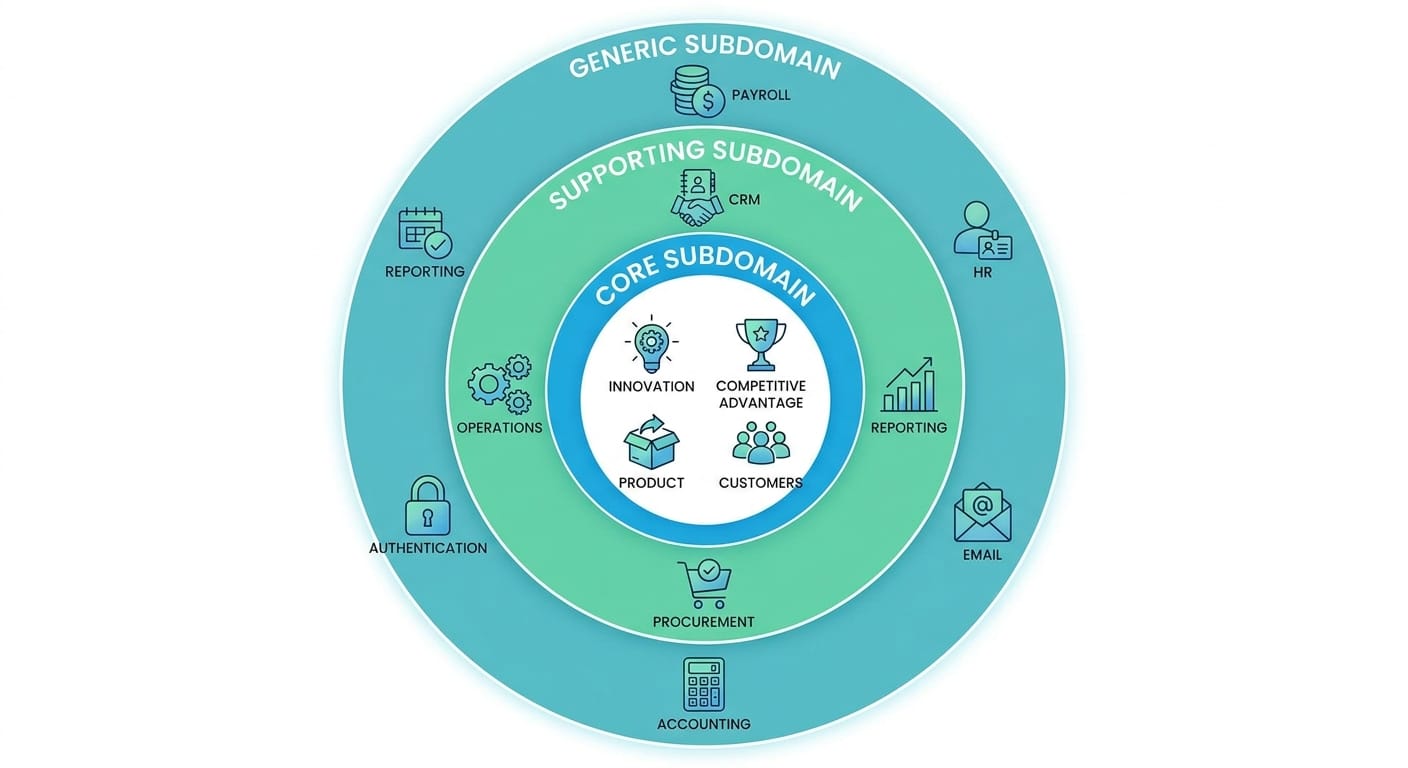
A business can be divided into multiple subdomains.
These subdomains generally fall into three categories:
| Category | Purpose | Competitive Advantage |
|---|---|---|
| Core | Defines the business | High |
| Supporting | Enables business operations | Medium |
| Generic | Common across industries | Low |
Generic Subdomain
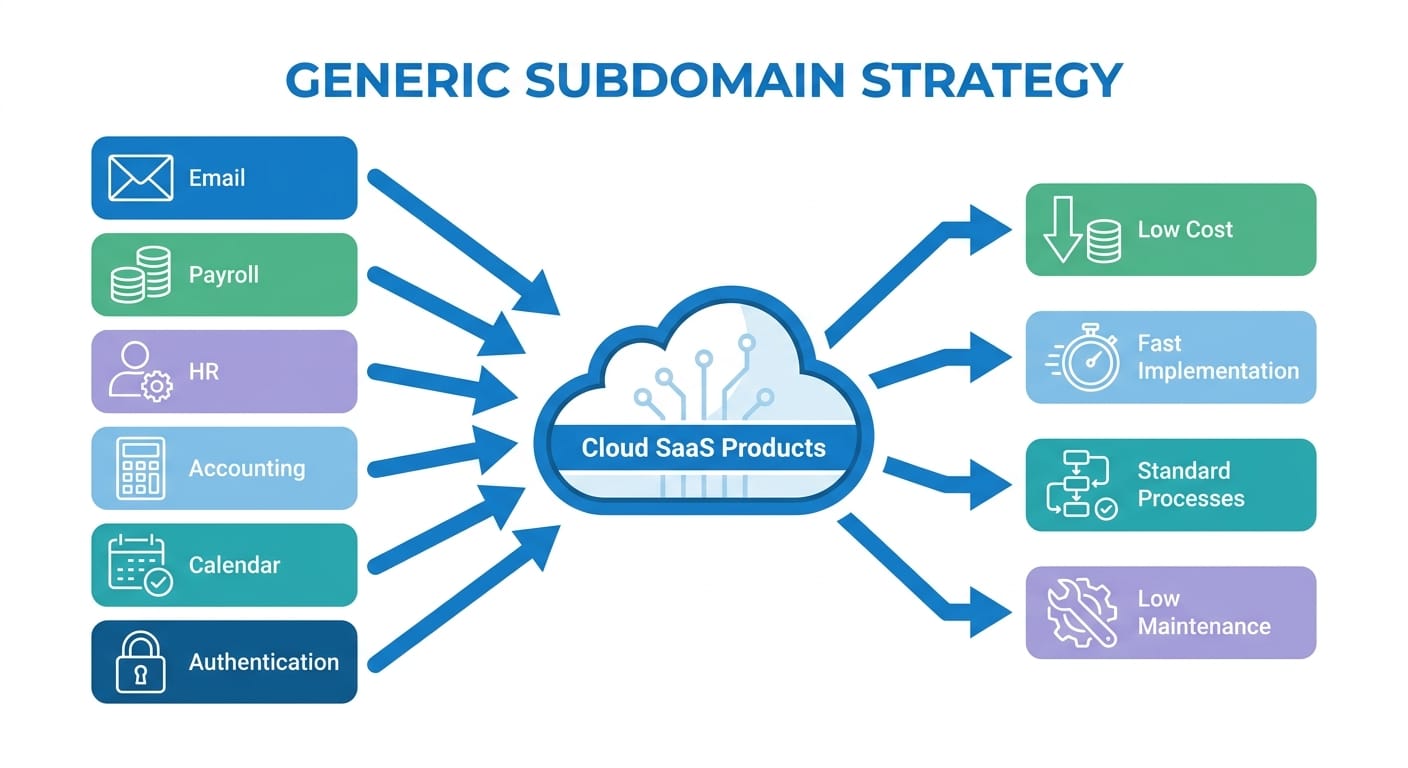
Generic subdomains solve problems that almost every organization has.
Examples include:
- Payroll
- HR Management
- Accounting
- Calendar
- Authentication
These functions rarely differentiate one company from another.
Recommended Strategy
✅ Buy established products
or
✅ Use SaaS platforms
Examples:
- Microsoft 365
- Google Workspace
- SAP SuccessFactors
- Workday
Building these systems usually offers little business value.
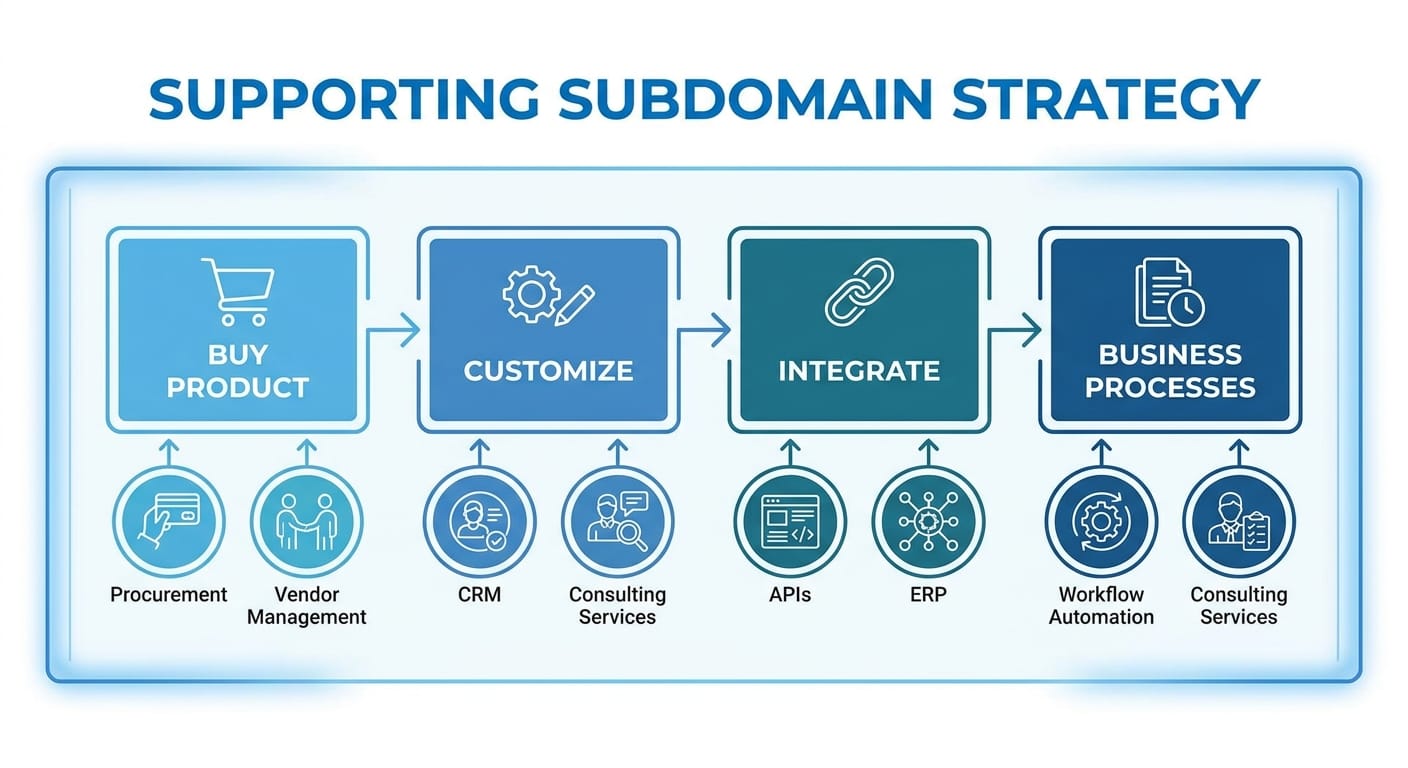
Supporting Subdomain
Supporting subdomains are important but are not the primary reason customers choose your business.
Examples:
- CRM customization
- Vendor Management
- Procurement
- Reporting
- Customer Support
These systems often require organization-specific workflows.
Recommended Strategy
- Buy a mature product
- Customize where necessary
- Outsource implementation if appropriate
This provides flexibility without reinventing existing capabilities.
Core Subdomain
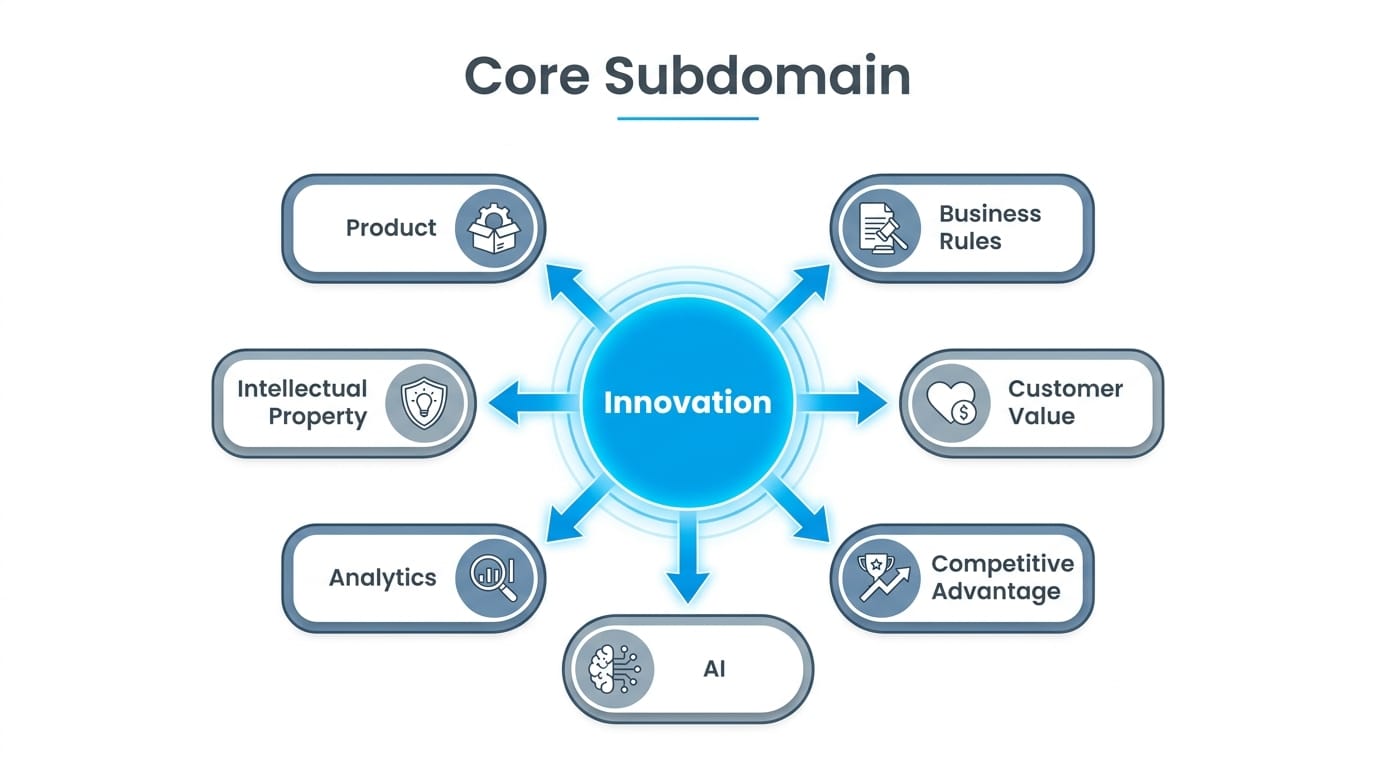
Core subdomains are where the organization creates unique value.
They represent the company's competitive advantage.
Examples:
- Recommendation engine (Netflix)
- Search algorithm (Google)
- Route optimization (Uber)
- Pricing engine
- Risk model
- Trading platform
These capabilities differentiate the business from competitors.
Recommended Strategy
✅ Build internally
Maintain ownership of:
- source code
- business rules
- intellectual property
- innovation
This is where the organization's best engineering team should focus.
Why Categorization Comes Before Build vs Buy
Many organizations make Build vs Buy decisions too early.
Instead, they should first ask:
Which business subdomain does this solution belong to?
Once categorized, the strategy becomes much clearer.
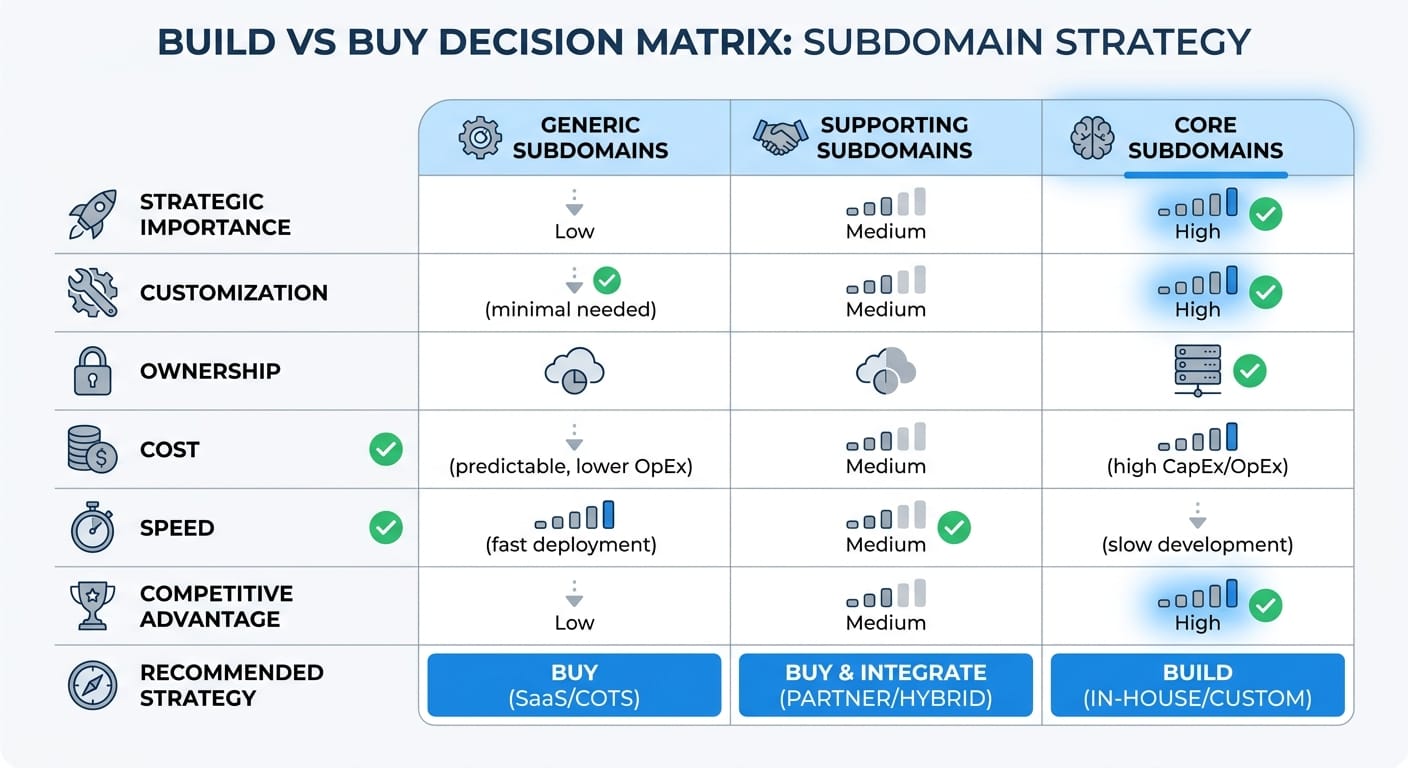
| Category | Strategy |
|---|---|
| Generic | Buy |
| Supporting | Buy + Customize / Outsource |
| Core | Build In-house vs Build with an Outsourceing Partner |
Categorization removes ambiguity and aligns technology investment with business goals.
Core Subdomain: Build or Outsource?
Core subdomains represent the organization's competitive advantage. They contain the business logic, proprietary algorithms, and unique processes that differentiate the company from its competitors.
Unlike generic or supporting subdomains, core capabilities should rarely be purchased as off-the-shelf products because doing so may limit differentiation.
However, organizations don't always need to build everything with a fully in-house engineering team.
The real decision is often:
Build with your own team or Build with a trusted outsourcing partner.
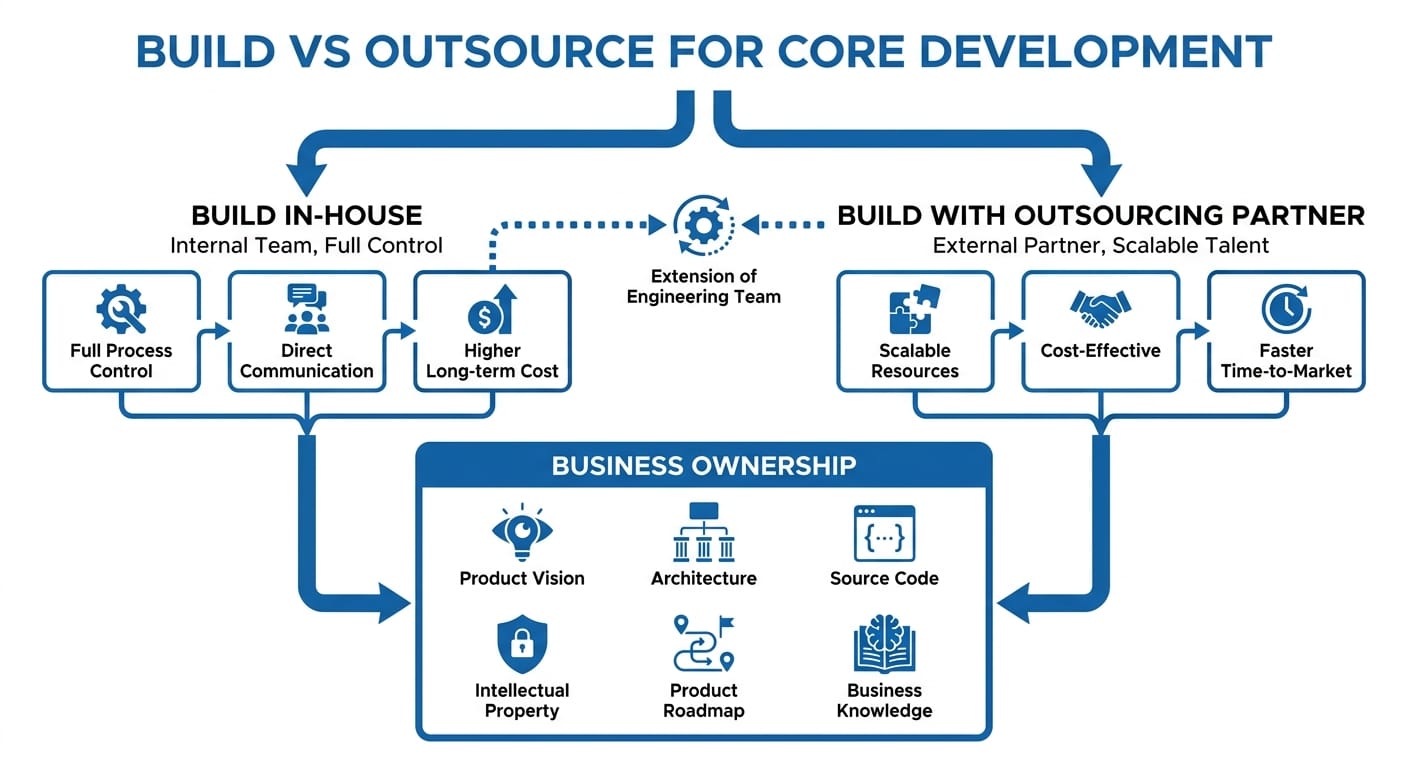
Option 1: Build In-house
Building internally is ideal when:
- The capability is strategically critical.
- Business requirements evolve rapidly.
- Close collaboration with domain experts is required.
- The organization wants complete ownership of the product and intellectual property.
- Long-term innovation is a priority.
Advantages
- Complete control over architecture and roadmap
- Faster business feedback loops
- Strong knowledge retention
- Better protection of intellectual property
- Continuous innovation
Option 2: Build with an Outsourcing Partner
Outsourcing does not mean giving away your competitive advantage.
Instead, it means extending your engineering capacity while retaining ownership of the solution.
The business continues to own:
- Product vision
- Business rules
- Architecture decisions
- Intellectual property
- Source code
- Product roadmap
The outsourcing partner contributes engineering expertise and delivery capacity.
When Outsourcing Makes Sense
- Need to scale engineering teams quickly
- Limited availability of specialized skills
- Faster time-to-market is important
- Temporary increase in development workload
- Cost optimization without compromising ownership
Benefits of Outsourcing Core Development
- Access to experienced engineers
- Faster product development
- Reduced hiring time
- Flexible team scaling
- Lower operational overhead
- Ability for internal teams to focus on product strategy and innovation
The key is that the outsourced team works as an extension of the internal engineering organization, not as an independent owner of the product.
Build vs Outsource Decision
| Factor | Build In-house | Build with Outsourcing Partner |
|---|---|---|
| Product Ownership | ✅ Internal | ✅ Internal |
| Intellectual Property | ✅ Internal | ✅ Internal |
| Engineering Team | Internal employees | External delivery team |
| Speed to Scale | Medium | High |
| Hiring Effort | High | Low |
| Long-term Knowledge | Highest | Shared through documentation and collaboration |
| Best For | Long-term strategic capability | Rapid execution with retained ownership |
Important Principle
Whether development is performed by internal employees or an outsourcing partner, the organization should retain ownership of the product, architecture, intellectual property, and business knowledge.
The strategic mistake is not outsourcing development—it is outsourcing ownership and decision-making.
Think of outsourcing as adding more skilled engineers to your team, while keeping product strategy, business expertise, and innovation firmly under your control.
             Core Business Capability
                      │
      ┌───────────────┴───────────────┐
      │                               │
 Build In-house                 Build via Outsourcing
      │                               │
      └───────────────┬───────────────┘
                      │
          Business Owns Everything
    • Product Vision
    • Architecture
    • Source Code
    • Intellectual Property
    • Product Roadmap
Build vs Buy Decision Matrix
| Business Category | Strategic Importance | Recommended Approach |
|---|---|---|
| Generic | Low | Buy |
| Supporting | Medium | Buy + Customize |
| Core | High | Build |
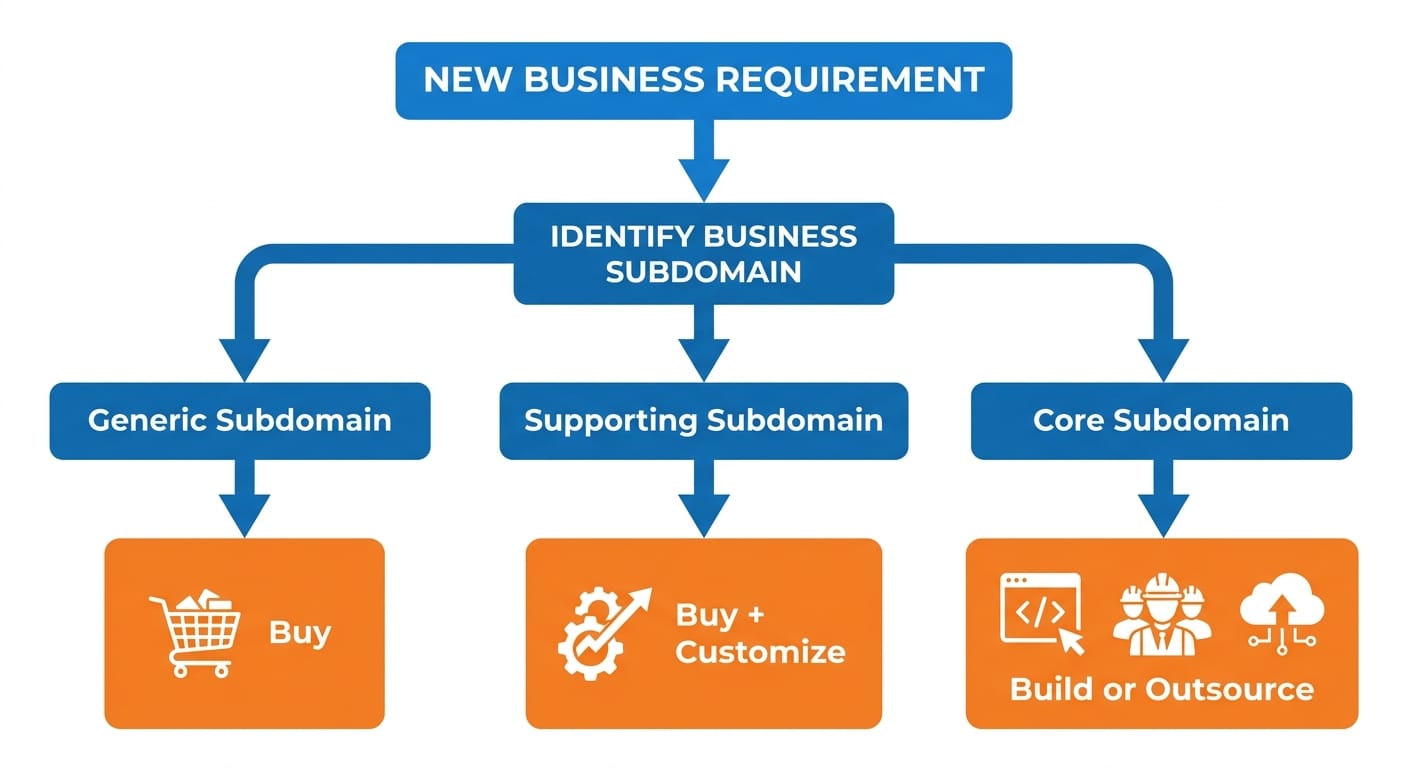
Decision flow:
New Requirement
        │
        ▼
Identify Business Subdomain
        │
        ├──────── Generic ───────► Buy
        │
        ├──────── Supporting ────► Buy + Customize
        │
        └──────── Core ──────────► Build
Maximizing ROI Through Core Investment
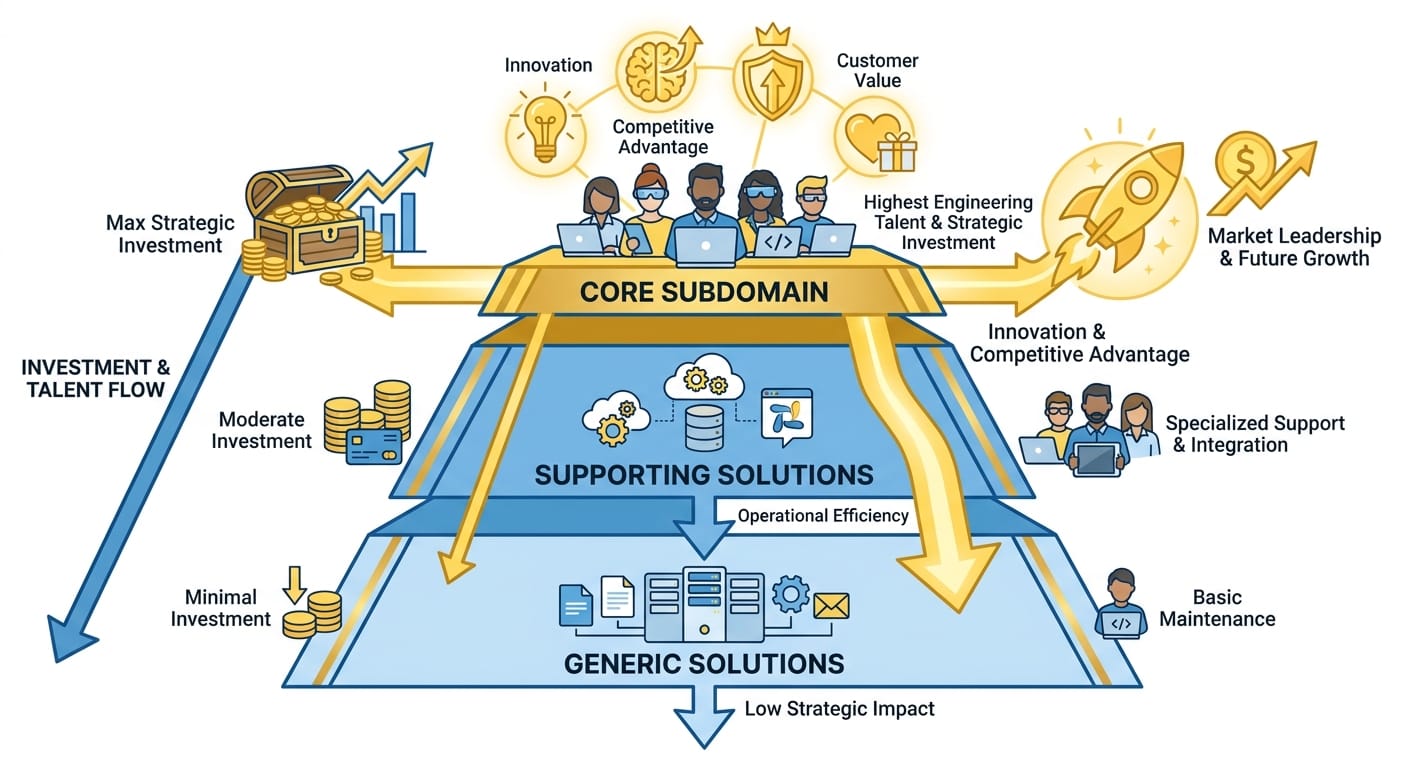
Technology budgets are always limited.
Organizations achieve the highest return on investment by allocating their best resources toward core business capabilities.
Instead of spending months building payroll or email systems, engineering teams should focus on solving problems that directly improve:
- customer experience
- revenue generation
- operational excellence
- competitive differentiation
This creates long-term strategic value.
Common Mistakes
Building Generic Solutions
- Reinvents existing software
- High maintenance cost
- Low business value
Buying Core Capabilities
- Loss of differentiation
- Vendor dependency
- Limited innovation
Treating Every Requirement as "Special"
Not every business process is unique.
Many organizations overestimate the uniqueness of their operations, resulting in unnecessary custom development.
Key Takeaways
- Build vs Buy is a business strategy, not just a technical decision.
- Categorize business domains before selecting a technology approach.
- Buy solutions for generic capabilities.
- Buy and customize supporting capabilities.
- Build core capabilities using the organization's strongest engineering team.
- Invest engineering effort where it creates competitive advantage.
- Businesses maximize ROI by focusing technology investment on their core subdomains.
Final Thought
A successful technology strategy is not about building everything.
It is about building only what makes your business unique and leveraging proven solutions for everything else.
Organizations that consistently apply this principle deliver software faster, reduce costs, and invest where innovation creates the greatest business value.